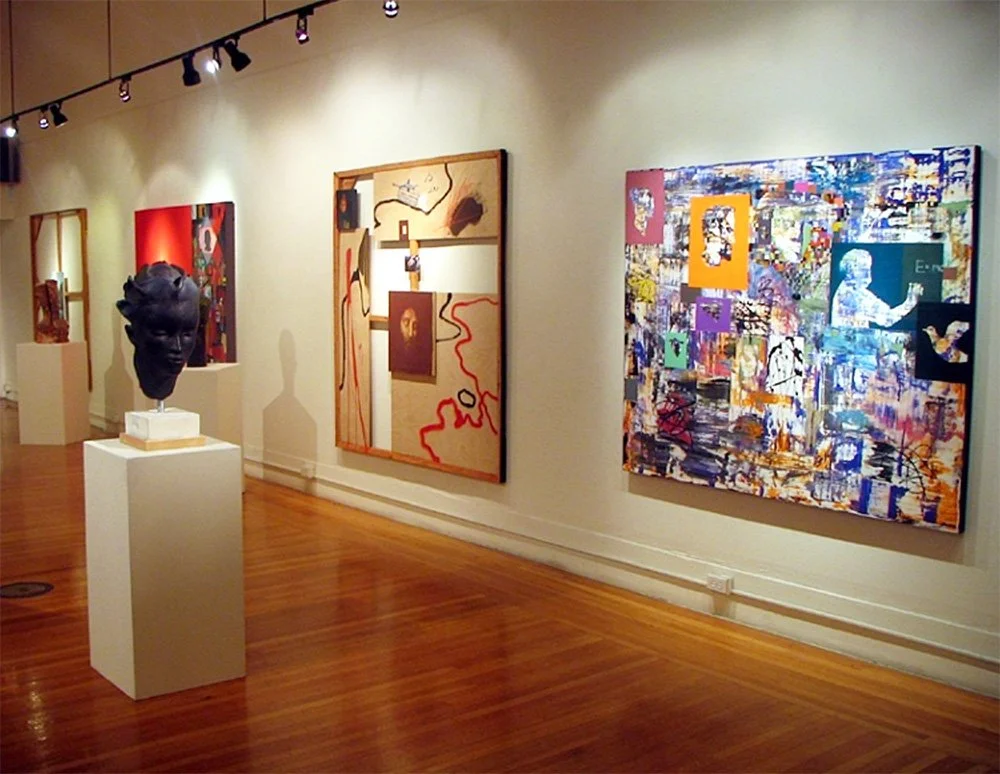
Joyce Gordon Gallery, Oakland, CA. 2007 | Canvas and Clay | Paintings: Rodney Artiles, Sculpture: Chukes.
Rodney Artiles creates densely layered paintings that function as experimental visual fields where perception itself becomes the subject. Working within a self-coined methodology he calls “recognitionism,” he merges collage, gestural abstraction, and deliberate figuration into archaeological sites of consciousness. These works don’t simply depict memory—they enact the mechanism by which memory operates.
At first glance, his canvases appear chaotic: paint and collage freely mix, offset by geometric color blocks containing ghostly images that emerge from surrounding abstractions. Calligraphic marks interrupt carefully rendered profiles, and surfaces bear the scars of scraping and layering that suggest accumulated time compressed into single pictures. Yet within this apparent disorder, specific forms emerge with crystalline clarity—a classical profile, a ballerina, an apple, Einstein writing his famous equation. These are deliberate excavations.
Interdisciplinary Vision
Recognitionism reveals itself as genuinely interdisciplinary. Whether processing art history or theoretical physics, the human mind operates through pattern recognition. Artiles’s paintings reveal the cognitive mechanism by which we make complex ideas comprehensible. Visual archetypes—equations, human silhouettes, doves, dripped paint suggesting vibrating strings—transform abstract concepts into navigable territory.
The Profile as Anchor
Throughout his work, one form recurs: the silhouetted profile, particularly of the female head. This classical motif—echoing cameos, coins, Renaissance portraits—functions as recognitionism’s primary archetypal anchor. It is the most economical representation of “human” in Western visual culture: a continuous outline that immediately registers as face, person, presence, and the seat of consciousness.
Photography as Complementary Practice
Artiles’s black and white photography reveals a complementary investigation. Where his paintings explore how multiple archetypal forms coexist within layered visual fields, his photographs isolate singular archetypal presences: monumentalized trees, Rodin sculptures transfigured by light and reflection.
His photographs layer sculptures with their reflections in glass and the ghostly figures of passing visitors. Past and present, original and echo coexist—a photographic analog to his paintings’ temporal layering. Both mediums pursue the same end: revealing the emotional and archetypal interior hidden within surfaces.
The Healing Arts Connection
Artiles holds degrees in both painting and Chinese medicine, maintaining a clinical practice alongside his studio work. Traditional Chinese medicine is fundamentally pattern recognition: practitioners recognize patterns of heat, cold, deficiency, excess, stagnation. Both recognitionist painting and diagnostic medicine require cultivated seeing—the ability to perceive meaningful patterns within apparent chaos.
His paintings function as training devices for perception, teaching viewers to see as he sees. They create a space where artist and viewer meet through mutual recognition of archetypal forms—exercises in collective pattern recognition.
Archetypes as Cognitive Shortcuts
Artiles describes recognitionism as “a testament to the fact that in order to remember things, to read and understand the world, we use archetypes to recognize our surroundings.” We don’t perceive the world as pure data; we perceive it by recognizing patterns we already know. His paintings make this cognitive mechanism visible and experiential.
His archetypal forms—profiles, apples, doves, horses, ballerinas—exist in the actual functioning of human perception and memory. They are the shapes consciousness makes when it tries to hold onto experience.
A Theory of Knowledge
Recognitionism is an epistemological method—a theory of how knowledge works disguised as a painting practice. Artiles demonstrates that understanding happens through recognition rather than pure observation. His paintings show us not what we see but how we see—the process by which the mind extracts figure from ground, signal from noise, meaning from chaos.